Sullivan Farm
The DrySullivan Farm is both a working place under pressure from drought and the setting of a last-day encounter between Jamie Sullivan and Luke Hadler. Reached by Aaron Falk and Greg Raco as they investigate Luke’s death, its fields first present the routine labor of farming; Sullivan’s recollection then turns that landscape into the site of a rabbit hunt whose details matter to the inquiry.
Fields and Farmhouse
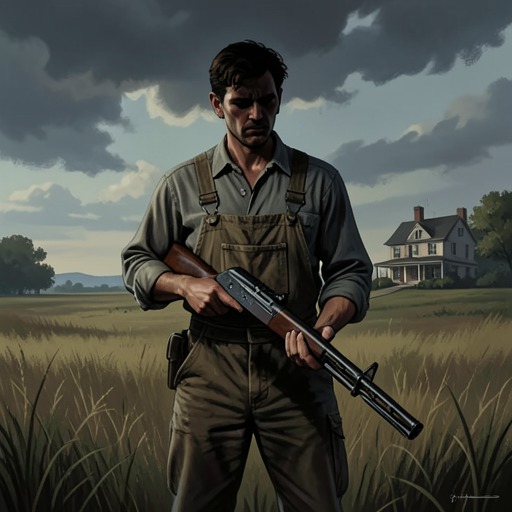
When Falk and Raco cross the fields, Sullivan has already been at work for more than four hours. They find him on one knee with his bare hands in the dry dirt, examining the soil closely. The image makes the conditions of farm work tangible: his attention is fixed on the ground itself, in a period when the drought has made the land difficult to manage. The account gives no measurements of the farm or wider description of its boundaries, but it establishes open fields as the setting for both Sullivan’s labor and the encounter he later recounts.
Sullivan leads the officers toward a low brick building, saying they can talk inside and that he needs to check on his gran. The movement from exposed field to house shifts the interview from the work site into a domestic setting. A teacup rattles against its saucer there as Mrs. Sullivan sets it down on a pile of novels. That small sound belongs to the officers’ present-day conversation, not to the earlier hunt, but it helps frame the farm as a place where the investigation enters an ordinary household as well as an agricultural workplace.
Work Under Drought
Sullivan identifies rabbits as a problem for the farm. The drought is already making it hard to get through the season, he explains, and rabbits threaten what remains worth eating. The animals are therefore not simply part of the rural scenery: they are a practical pressure on food and work, and the reason Sullivan gives for the hunt with Luke. His complaint had come up the previous night at The Fleece pub, where Luke offered to help. Sullivan cannot recall specifically who heard them arrange it, only that the place was busy enough for anyone listening to have heard.
The farm’s dry soil and the rabbits’ attack on crops describe different aspects of the same strain. Sullivan’s careful inspection of the ground shows labor directed at the conditions of the land; the proposed hunt is a response to animals eating what the farm needs to produce. The evidence presents these pressures through practical details rather than through a separate account of the drought’s wider effects. At Sullivan Farm, environmental hardship appears as daily work, damaged prospects, and the need to deal with pests.
Luke’s Visit and the Hunt
In Sullivan’s account, Luke arrives at the entrance to a field in his truck, five minutes early. Sullivan is already there. The two men greet one another with raised hands; Luke reaches into the cargo tray for his shotgun, while Sullivan hands him ammunition. The exchange gives the visit a specific purpose and establishes that Sullivan supplied the ammunition used during their outing. It also places the gun among the ordinary equipment of the trip, before Falk and Raco ask further questions about the ammunition’s kind.
They spend about an hour hunting. Luke eventually stretches, says he thinks they have made a dent in the rabbits, checks his watch, and returns the spare ammunition to Sullivan. Together they walk back toward the truck. Sullivan’s account characterizes the tension between them as having dissolved by then, though it does not explain its source in these moments. The change matters to the shape of the recollection: the hunt ends not in an argument but in a shared return from the field.
Luke puts his unloaded gun in the passenger-side footwell and climbs into the truck. Once he has decided to leave, he seems hurried; he rolls down the window, gives a short wave, and drives away. Sullivan remains alone in the empty field, watching the silver truck disappear. The contrast between their departure and his stillness gives the farm scene a distinct ending, while leaving the reason for Luke’s haste unresolved.
Place in the Investigation
Sullivan Farm is introduced through an interview, then becomes the setting of a remembered sequence reconstructed for Falk and Raco. This shift connects the present inquiry—the officers crossing the fields and questioning Sullivan—to Luke’s earlier visit. The farm’s specific features make the account concrete: the entrance to the field, the cargo tray, the exchanged ammunition, the passenger footwell, and the truck disappearing from view. The officers can ask about actions and objects that Sullivan places in this setting, rather than relying only on a general account of the two men’s plans.
The location’s significance rests on that practical chain of events. Sullivan’s complaint about rabbits explains why he says Luke came; the ammunition exchange establishes what Sullivan handed over; the hour in the field and Luke’s departure provide the sequence Sullivan recounts. Yet the scene does not resolve every question raised by the investigation. Luke’s hurried exit is observed but not explained, and the earlier tension is noted without being identified. Sullivan Farm thus serves as a grounded but incomplete witness to Luke’s movements: a working landscape whose ordinary details become evidence, while its final image—the solitary farmer and the receding silver truck—preserves what the account cannot settle.